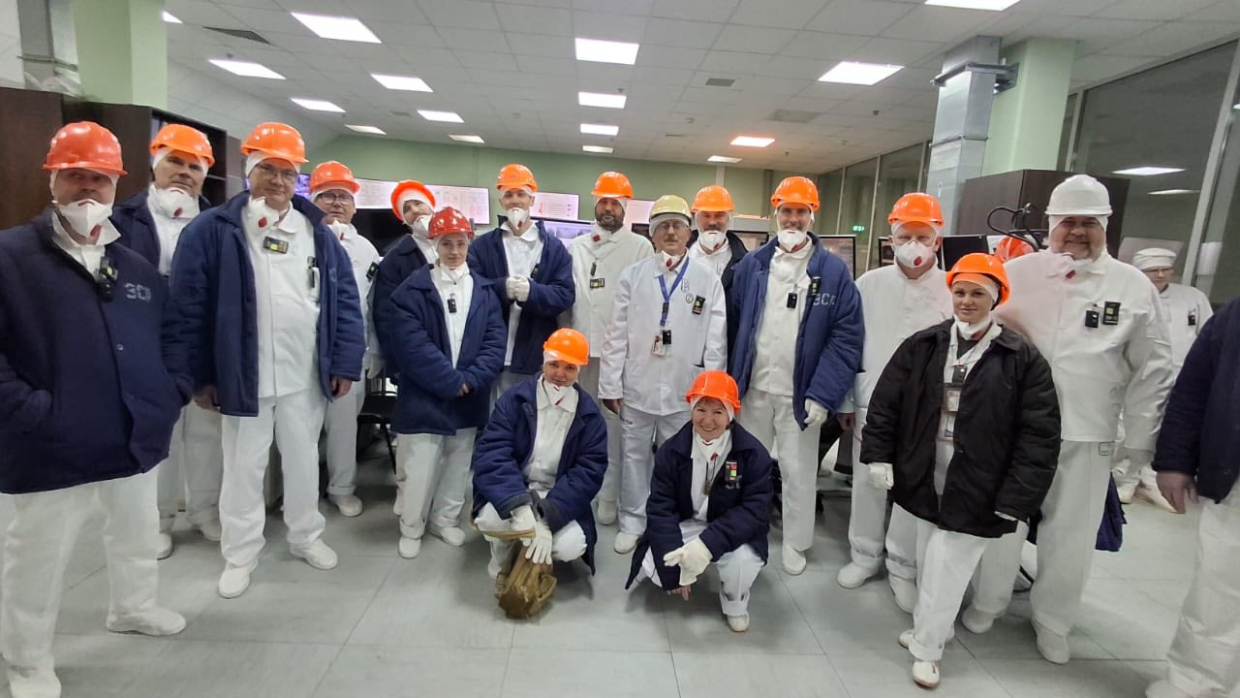
On April 26, 2026, Ukraine marked 40 years since the Chornobyl disaster — the largest civilian nuclear accident in human history. The team of the Initiative E+ NGO, together with its longtime partners — Denmark's Biler til Ukraine and the Finnish-Swedish Karavanen till Ukraina — was invited to the commemorations at the plant itself. Not as guests. As partners.
That distinction matters.
For months on end, the donors who work with Initiative E+ have been bringing vehicles, generators and other critical equipment to Ukraine — for hospitals, for military units, for emergency response crews, and for the Chornobyl plant itself. Supporting the plant is part of this systematic work: different items, different deliveries, different moments when help is needed right here and now.
One of the publicly visible episodes of that cooperation came in February 2026. Initiative E+, together with Biler til Ukraine, handed over two vehicles to the Chornobyl plant's emergency repair crews, who since February 6 had been helping clean up after Russian strikes on infrastructure in Kyiv. The plant's general director, Serhii Tarakanov, commented briefly: "The ChNPP fleet is fairly limited, and the war hasn't improved the situation. We're confident that this help from Initiative E+ will improve the efficiency of emergency repair work in Kyiv."
The work hasn't stopped since. And that's precisely why the invitation to the 40th anniversary came naturally — as recognition of an ongoing partnership. A different level of trust. And a different level of responsibility.
The delegation walked what's known as the "presidential route" — a closed tour reserved for the highest-level official delegations. The "gold" corridor, the control panels of reactors 3 and 4, the New Safe Confinement over the sarcophagus, and its control room.
Standing in these rooms is its own kind of experience. In the control room of reactor 4 — where, at 1:23 a.m. on April 26, 1986, the disaster began — you understand the critical cost of a human error with absolute clarity. And just as clearly, you understand why the world, and Ukraine today, keep working to make sure that kind of error is never repeated.
Four decades on, the Chornobyl plant is not a museum. It's a working facility, where shifts of specialists ensure the plant's gradual decommissioning and its ongoing nuclear safety. That work has to be done in wartime conditions: in February 2025, a Russian drone strike punctured the outer shell of the New Safe Confinement — the arc built in 2016 specifically to isolate the 1986 sarcophagus. Repairs will cost hundreds of millions of dollars. And the broader threat to nuclear safety — from attacks on Ukrainian nuclear plants to the ongoing occupation of Zaporizhzhia NPP — remains one of the sharpest issues of this war.
In that context, partnership with Chornobyl isn't a symbolic gesture. It's concrete support for a working site that, day by day, carries part of the burden of Ukrainian and European security.
Initiative E+ builds its cooperation with the Chornobyl Nuclear Power Plant State Specialised Enterprise not as a one-off campaign, but as one of the steady lines of its work — alongside vehicle convoys for the Armed Forces, medical aid to hospitals, and energy caravans for hospitals and stabilisation points near the front. All of it comes down to the same thing: supporting the people on whom Ukraine's ability to hold the line actually depends.
The invitation to the 40th anniversary isn't a ceremonial photograph for the archive. It's confirmation that the partnership works, that it's trusted, and that it will continue.
We are proud of our partnership with the Chornobyl NPP. And we keep helping.
How to get involved: visit our SUPPORT page.
Thank you to everyone standing with us.